Warming is set to pass the threshold within a few years, a UN report says, and the task now is to bring it back down.
Global warming is set to pass 1.5°C around the end of the decade. A new UN Environment Programme report, Limiting Overshoot, says this doesn’t mean we should abandon the target. Instead, we must prepare for a warmer world while keeping peak temperatures as low as possible and bringing them back down by the end of the century.
Global climate policy must now shift from avoiding overshoot to navigating it. Together with the long-term goal of limiting warming to 1.5°C, this shift will shape international climate policy from now on. Our actions today will determine how high temperatures climb, how long they stay there and if a way back is still possible.
What are overshoot pathways?
First and foremost, there is a difference between the use of the word “overshoot” in everyday language and “overshoot pathway” in the scientific literature. The former refers to “the action or result of exceeding a limit or target” and the latter to a pathway that returns global warming below a specified limit after first having exceeded it for a certain amount of time.
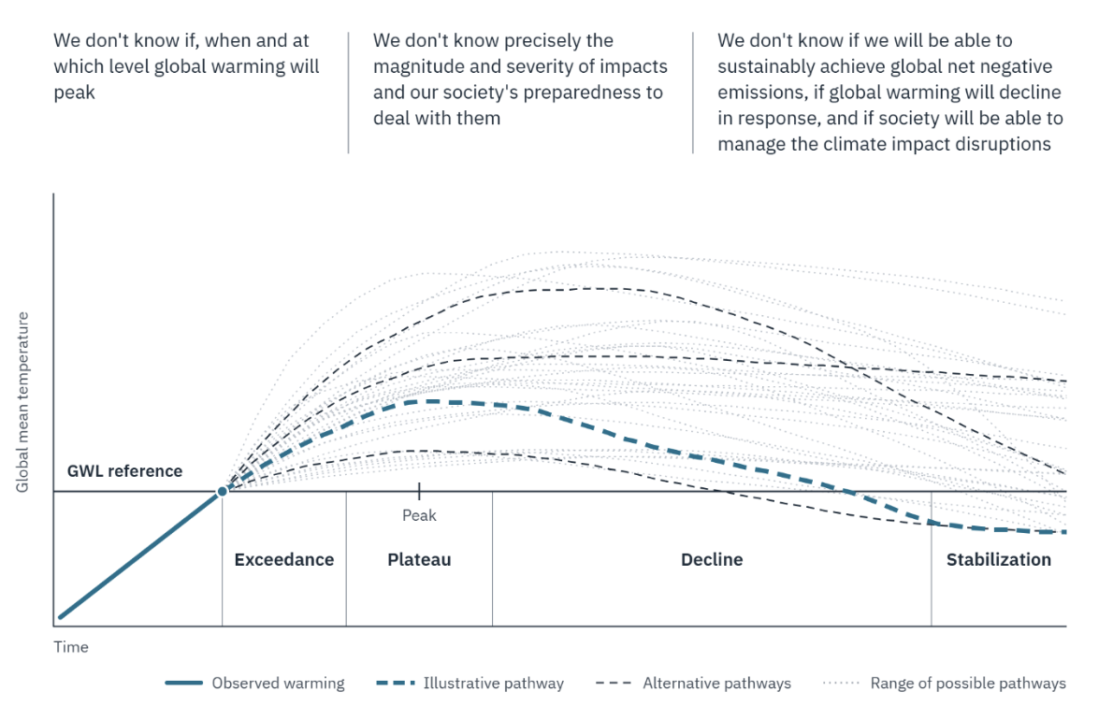
The overshoot pathway consists of four stages (Figure 1):
- Exceedance
- Peak
- Decline
- Stabilisation
In the first stage, the temperature exceeds 1.5°C; the second stage is where the temperature reaches its maximum, above 1.5°C; after that comes the period of decline and, finally, the stabilisation of the temperature below 1.5°C. Each of these stages requires its own adaptation and mitigation strategies.
Figure 1: Overshoot pathway
Source: UN Environment Programme, Limiting Overshoot report
In simple terms, overshoot is not a threshold that’s being passed, like the temperature exceeding 1.5°C; it’s a process that will occur in several stages and over decades.
Entering the era of exceedance
With the current temperature rises and billions of tonnes of greenhouse gases emitted every year, it is likely we will exceed the threshold by the end of the decade. While exceedance is unavoidable, bringing the level back down below 1.5°C is still theoretically possible.
Due to inadequate climate action, world temperatures keep rising to historically high levels, and in order to secure a future where temperatures stabilise below 1.5°C, massive cuts to emissions are needed.
Gaps in the system
The Paris Agreement (2015) established a framework for national climate pledges, known as Nationally Determined Contributions (NDCs), committing countries to limiting global warming to well below 2°C, while pursuing efforts to limit it to 1.5°C.
However, analysis of the NDCs submitted shows that current efforts are nowhere near the reductions needed, with GHG emissions rising continuously. Another challenge is that the policies currently in place fall short of national pledges, creating an implementation gap.
These gaps have three consequences:
- Under current policies, global warming reaches around 2.6°C by 2100
- the most stringent emission reduction pathways that were available around the time of the Paris Agreement are no longer feasible
- the minimum peak level of warming has increased
Climate risks and impacts of a world above 1.5°C
We are already feeling the climate impacts of a world at 1.5°C, and even this increase is dangerous for nature and humans. 2024 was the first year in which the global mean temperature rose above 1.5°C, and we have now entered a 20-year period with mean warming of 1.5°C.
We are already experiencing some of the most severe impacts:
- More than 80% of tropical coral reefs suffered bleaching between 2023 and 2025.
- 40% of glacier loss since the 1970s happened in just the last decade, with combined Arctic and Antarctic sea ice hitting a record low in February 2025.
- From May 2024 to May 2025, about half the world’s population experienced at least 30 days of extreme heat. Heat deaths during a 2025 European heatwave were estimated to have tripled because of climate change.
- Some communities and ecosystems are already reaching the limits of what adaptation can do.
Even with stabilisation below 1.5°C, many of these impacts will be permanent, changing the world as we know it. While some of those impacts can still be reversed, limiting the peak global temperature is key, and if no action is taken, it might not be possible to reverse the effects.
Furthermore, overshoot, peak and decline will continue to create more and more risks. At the moment, risks are not fully known or predictable across all stages, but we can be certain they will have a big impact on people, biodiversity, development and the planet.
In the decades to come we can expect more cascading and interconnected risks:
- Risks grow faster than temperatures: the higher the peak and the longer it lasts, the greater the damage. Hazards like heatwaves, droughts and floods are more likely to hit at the same time.
- Tipping points: there is a growing risk of irreversible changes to the Greenland and West Antarctic ice sheets, the Atlantic Ocean circulation (AMOC) and the Amazon rainforest.
- Sea-level rise: glaciers could lose more than a quarter of their mass by 2100. Some small island states and low-lying coastal cities could be partly or completely submerged.
- Food and water: without effective adaptation, global food production could fall by up to 14% by 2050. Water supplies will also come under pressure.
- Health: heatwaves will be longer and more frequent, and diseases will spread into new areas. Without adaptation, deadly summers could become normal at 1.5–2°C.
- Cities: by 2100, 84% of people will live in urban areas, which face longer heatwaves, soaring energy demand and rising costs for consumers. Low-income neighbourhoods will be hit hardest.
It’s worth noting that as the world adapts to these new climate challenges, the risks will change throughout every stage of overshoot. As the report notes, if and when temperatures return to 1.5°C or below, human systems will already have been reshaped, while natural systems may have reorganised or remain in transition, meaning that new adaptation challenges and opportunities will continuously emerge in this complex system.
The way back: net zero is not a goal, it’s a milestone
It’s clear that in order to return to 1.5°C above pre-industrial levels, a combined effort of mitigation and adaptation actions is needed, and the whole process is far more complex than reaching net zero by 2050.
Mitigate warming
The first step is deep cuts to greenhouse gas emissions, especially methane, which has a high global warming potential (GWP), to achieve net zero emissions. Global emissions need to be cut by 55% from 2019 levels by 2035, but because action has been delayed, that is now even harder to achieve. After that, continuous net-negative emissions are required in order to reach the desired stabilisation stage below 1.5°C.
Apart from cutting emissions, it’s crucial to scale up renewables, stop building new fossil fuel infrastructure, improve energy efficiency, protect forests and natural carbon stores, and utilise carbon dioxide removal (CDR) without relying on it. Bringing temperatures down requires removing more CO₂ than is emitted in the second half of the century. However, removal must come on top of emission cuts, not replace them. Even optimistic scaling of CDR is unlikely to lower temperatures by more than a few tenths of a degree this century.
Adapt to new realities
Adaptation must go hand in hand with mitigation. In a warmer world, it is no longer optional, and it must be flexible enough to change as the climate does. Early warning systems, heat action plans and social protection need to be in place before warming peaks, not set up in response to it. Plans should favour options that can be adjusted step by step, and they should be updated regularly, since past climate data is no longer a reliable guide.
It’s crucial to look beyond the peak, because farming and infrastructure built for the hottest years may need readapting as temperatures fall. Where possible, adaptation should support mitigation too: urban trees, for example, cut both heat deaths and cooling demand. Where adaptation reaches its limits, countries will need ways to deal with loss and damage.
Implications for companies
Global warming is set to cross 1.5°C above pre-industrial levels within the next few years, and even in an optimistic scenario where all national pledges and net-zero targets are met, warming is expected to peak at around 1.8°C. Companies need to anticipate how a changing climate will affect their operations, assets and value chains, and prepare for a more volatile and uncertain world.
How can companies prepare?
- Plan for a future above 1.5°C. Temperatures will continue to rise in the decades to come. Risk assessments and scenario analysis built around a “stay below 1.5°C” assumption are already outdated. Adaptation decisions are most sensibly guided by climate risks between 1.5°C exceedance and expected peak warming.
- Build supply chain resilience. Climate impacts and geopolitical instability are likely to disrupt supply chains for construction materials and energy. Increasing supplier redundancy across regions and climate zones can provide greater resilience.
- Expect physical and financial risks to rise. Many regions will be hit harder by extreme weather, and in some places the damage will be irreversible. As risks grow, some assets may become uninsurable, and insurers may withdraw from high-risk areas before warming peaks. Review your sites, suppliers and customers, and assess how insurance availability and costs could change.
- Cut emissions now and treat net zero as a milestone. A stable, predictable climate is essential for long-term business success. Companies should prioritise deep, near-term emission cuts and treat net zero as a milestone rather than the final goal. Returning global temperatures toward 1.5°C will require sustained net-negative emissions for decades, so decarbonisation strategies should be built with that longer horizon in mind.
- Watch for new policy and market frameworks. It’s clear that achieving stabilisation below 1.5°C will require strong political action. As we move through the stages of overshoot, policies and frameworks will continue to adapt and evolve. Governments will need new policies and institutions to scale CDR and provide clear investment signals to the private sector. This points to future regulation, the development of carbon removal markets, and evolving disclosure expectations.
- Hard-to-abate sectors face the toughest road. Agriculture, cement, steel, aviation and shipping are where residual emissions will linger, and methane reductions from agriculture and waste are crucial to bringing temperatures down. Companies in these sectors should expect increasing scrutiny and should be investing in abatement options now.
Conclusion
Decades of insufficient action have locked us into three compounding challenges to limiting temperature overshoot, with an urgent need for action now.
- Reducing emissions and addressing impacts
- Limiting peak warming and managing risks
- Sustaining decline and scaling adaptation
These challenges must be tackled in parallel to limit overshoot.
Actions in both mitigation and adaptation are urgent, mutually reinforcing, interdependent, and necessary to limit overshoot.
| Mitigation | Adaptation |
| Immediate policies and measures to reduce and avoid greenhouse gas emissions and slow the rate of warming | Urgent collective adaptation and transformational actions to protect all people and ecosystems from the impacts of a 1.5°C world and beyond |
| Advancing sustained and deep decarbonisation towards net zero emissions to limit peak warming and avoid a more dangerous overshoot world | Advancing adaptation and development strategies under higher levels of warming while managing severe and increasing impacts and risks |
| Achievement of sustained net-negative CO₂ emissions to reverse global warming | Continued efforts to enhance sustainability and support recovery where possible while managing persistent climate impacts and risks |
Overshoot of 1.5°C is no longer a distant scenario. It is becoming the context in which businesses, governments and communities will operate for decades to come.
For companies, this means moving beyond net-zero pledges towards deep, immediate emissions cuts, while building resilience into assets, operations and supply chains for a world that will be hotter and less predictable than the one they were designed for.
The decisions made in the next few years will determine how high temperatures peak, how long the overshoot lasts, and whether a return to 1.5°C remains possible. Every fraction of a degree of warming avoided matters, and the time to act is now.